
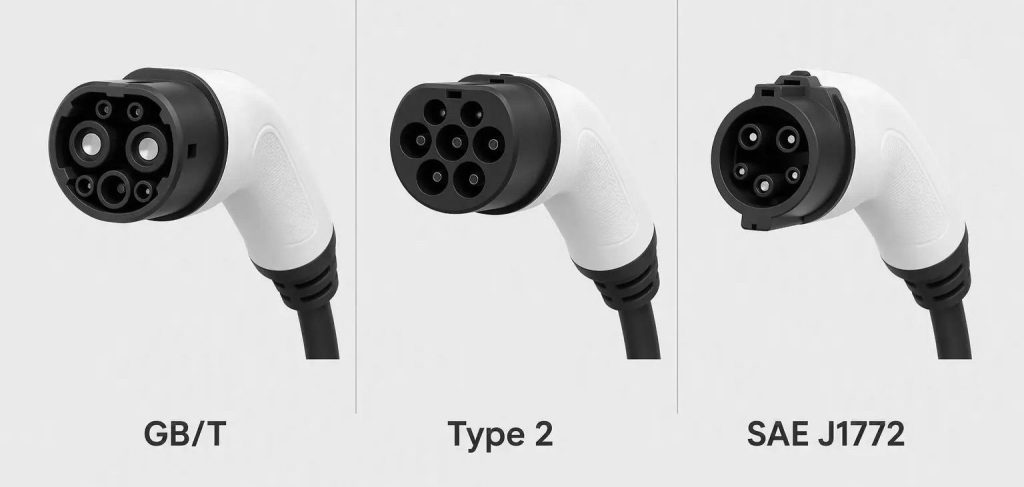

3 AC Charging Standards You Must Know Before Sourcing EV Charging Guns (GB/T vs Type 2 vs SAE J1772)
If you import or distribute EV charging guns, picking the wrong connector type is the single most expensive mistake you can make. Wrong standard = dead inventory, unhappy dealers, and a customer service ticket you can’t close. We’ve shipped over 50,000 guns to 30+ countries, and 90% of the “wrong product” returns trace back to one decision: the connector.
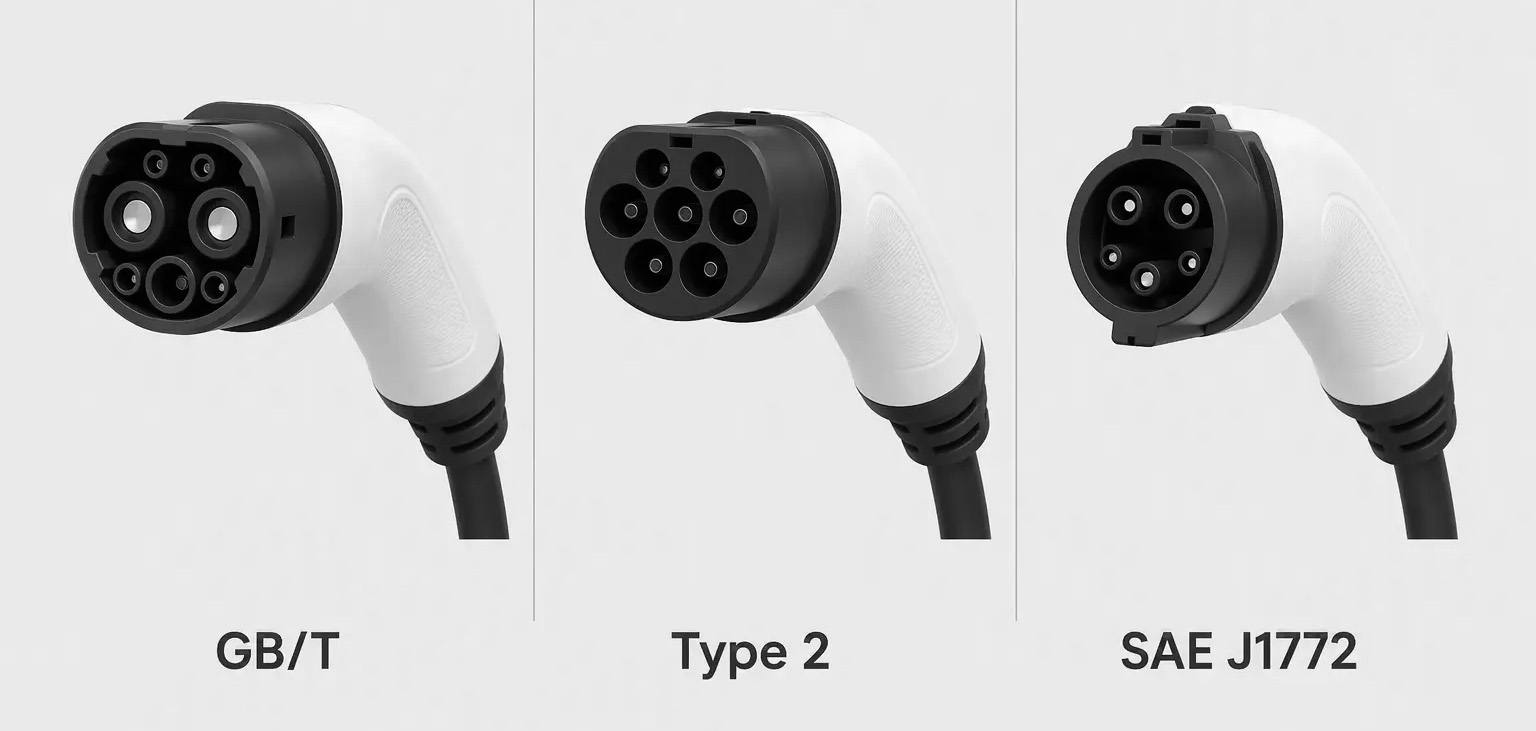
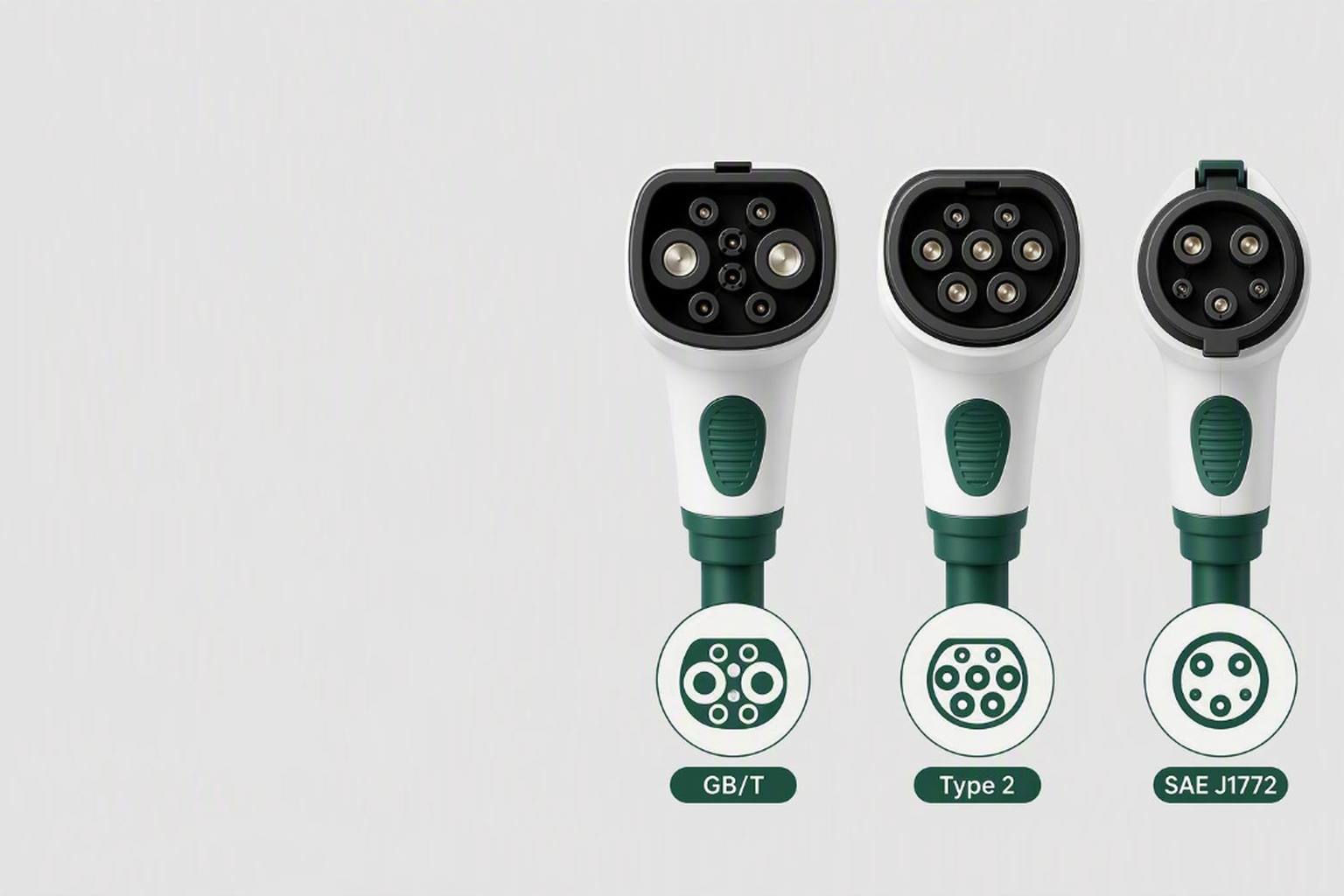
This guide walks you through the three dominant AC standards, GB/T, Type 2, and SAE J1772, so you can match the right gun to the right market, the right vehicle, and the right grid.
1. GB/T, China’s National Standard (AC + DC)
GB/T 20234 is the mandatory charging interface for any EV sold in mainland China, covering both AC (slow/standard) and DC (fast) charging. The AC variant uses a 7-pin round connector rated for 250V/440V and up to 32A single-phase or 63A three-phase. It’s physically incompatible with every other AC standard, there is no adapter that makes a GB/T plug fit a Type 2 inlet, and there never will be.
When you need GB/T: Any product destined for the Chinese market, including export models made in China for domestic re-import. Pair your GB/T AC gun with GB/T DC fast chargers for full ecosystem coverage, most fleet operators in China expect both from one supplier.
2. Type 2 (IEC 62196-2), The European Standard
Type 2, also called Mennekes after its inventor, is the universal AC connector mandated across the European Union. It supports both single-phase and three-phase power up to 480V / 63A (43 kW AC), which is why it’s the default at every public AC charging point in the EU, UK, and most of the Middle East. Type 2 also forms the physical basis for CCS2 (Combo 2) DC fast charging. The connector geometry is specified in IEC 62196-2.
When you need Type 2: Any product for the EU, UK, Australia, or markets following IEC 62196-2 (which is most of the world outside North America and China). If you’re sourcing for Europe, Type 2 is non-negotiable.
3. SAE J1772, The North American Standard
SAE J1772 (often just called “J1772”) is the AC charging standard across the United States, Canada, Mexico, Japan, and South Korea for Level 1 (120V) and Level 2 (240V) charging. It tops out at 240V / 80A (19.2 kW), and Tesla vehicles in North America ship with a J1772 adapter. The 5-pin round connector is single-phase only. The specification is maintained by SAE International.
When you need J1772: Any product for North America or Japan. Note that Tesla’s native connector (NACS) is rapidly replacing J1772 in new US installations since 2023 and is now standardized as SAE J3400. If you are sourcing for the 2025+ US market, evaluate NACS separately.
Side-by-Side Comparison
| Spec | GB/T (China) | Type 2 / IEC 62196-2 (EU) | SAE J1772 (North America) |
|---|---|---|---|
| Market | China | EU, UK, AU, most of world | USA, Canada, Japan, Korea |
| Voltage | 250V AC / 440V AC | Up to 480V AC | 120V / 240V AC |
| Max current | 32A (1φ) / 63A (3φ) | 16A / 32A / 63A | 12A / 16A / 32A / 40A / 48A / 80A |
| Max power | ~27.7 kW AC | ~43 kW AC | ~19.2 kW AC |
| Phases | 1φ + 3φ | 1φ + 3φ | 1φ only |
| Lock mechanism | Electronic latch | Electronic latch + motor | Mechanical latch |
| DC variant | GB/T DC (separate plug) | CCS2 / Combo 2 | CCS1 / Combo 1 |
How to Choose the Right Standard for Your Market
The decision is simpler than it looks. Match the gun to the vehicle fleet and the local grid in three steps:
- Identify the destination market first. China = GB/T. EU/UK = Type 2. North America = J1772. Trying to build “one gun for everywhere” doesn’t work because the plugs don’t physically fit.
- Check the local grid. Most EU industrial sites run three-phase 400V, Type 2 with 3φ cable supports up to 22 kW AC per gun. North American residential is single-phase 240V, J1772 40A or 48A is the sweet spot for home wallboxes.
- Plan for DC fast charging. If your customer is building a fast-charging site, the AC connector is just one piece, they’ll need the DC variant (GB/T DC, CCS2, or CCS1). Source both from one supplier to avoid connector compatibility issues across the fleet.
As a manufacturer producing all three standards under one roof, we can ship mixed-standard orders in one container, custom-label per market, and pre-test each gun on a real vehicle before packing. Get in touch for a market-specific spec sheet.
Certification Requirements by Market
Connector fit is the first filter; certification is the second. A gun that mates correctly but lacks the destination market’s approval cannot legally be placed on the market there.
| Market | AC standard | DC standard | Required certification | Reference test standard |
|---|---|---|---|---|
| China | GB/T 20234.2 | GB/T 20234.3 | CQC | GB/T 20234.1 |
| EU / UK | IEC 62196-2 Type 2 | CCS2 | CE, TUV | IEC 62196-1 |
| North America | SAE J1772 | CCS1 / NACS (SAE J3400) | UL, FCC | UL 2251 |
| Japan | SAE J1772 (Type 1) | CHAdeMO | PSE | JIS C 62196 |
| Australia / NZ | IEC 62196-2 Type 2 | CCS2 | RCM | AS/NZS 62196 |
Common Sourcing Mistakes to Avoid
Three traps we see from new importers every month:
- Buying “universal” adapters instead of matching the market standard. Adapters add failure points, void most vehicle warranties, and create customer service overhead. If your market needs Type 2, ship Type 2.
- Ignoring cable length and angle. A 5-meter cable that doesn’t reach the inlet is a return. We stock 3m / 5m / 8m / 10m, plus straight and coiled options. Tell us the parking layout before you order.
- Skipping the temperature rating. Outdoor charging in summer China or the Middle East needs a gun rated -30°C to +50°C, not the default 0°C to +40°C. Specify the operating environment when you request a quote.
Frequently Asked Questions
No. GB/T and Type 2 are physically incompatible, different pin layouts, different locking mechanisms. A vehicle with a Type 2 inlet requires a Type 2 gun (or CCS2 for DC fast). The only way to bridge the gap is a manufacturer-supplied adapter, which we do not recommend for regular use.
Yes, in North America. Tesla’s NACS connector was adopted by Ford, GM, Rivian, and most US automakers starting in 2023, and it’s becoming the de facto standard for new EV models from 2025 onward. However, J1772 will remain in service for legacy vehicles and home wallboxes for at least another 10 years. Many new charging stations now offer both NACS and J1772 (or J1772 adapters).
AC charging uses the car’s onboard charger to convert AC to DC, slow (3–43 kW), gentle on the battery, ideal for home and workplace. DC charging bypasses the onboard converter and feeds DC directly to the battery, fast (50–350 kW), used at highway stations. All three standards above describe AC connectors; their DC variants are GB/T DC, CCS2/Combo 2, and CCS1/Combo 1.
For Type 2, yes, the 3φ variant has 5 power pins vs 3 for 1φ. GB/T supports both in one connector. J1772 is 1φ only. Tell your supplier what your grid delivers before ordering.
For home wallboxes, 5m covers 90% of parking layouts. For commercial or fleet use where the charge point is set back from the parking bay, go 7m or 10m. Coiled cables save space but reduce usable length by ~25%.
Yes. We routinely ship mixed-standard orders, e.g., 200 GB/T + 300 Type 2 + 150 J1772 in one 20ft container, each pallet labeled by destination market. MOQ per standard is typically 50 units.
GB/T: CQC. Type 2: CE, TUV, IEC 62196-2. J1772: UL, FCC, Energy Star (for wallboxes). A genuine manufacturer will share test reports per batch; if your supplier can’t, walk away.
Stock standards (GB/T, Type 2, J1772 in standard lengths and colors): 7–15 days. Custom cable length, color, logo, or packaging: 25–35 days. Air freight available for urgent orders.
Need a market-specific spec sheet or a quote for mixed-standard orders? Send us your target market, vehicle fleet, and estimated quantity. We’ll reply within 24 hours with a comparison sheet, lead time, and FOB/CIF pricing.