
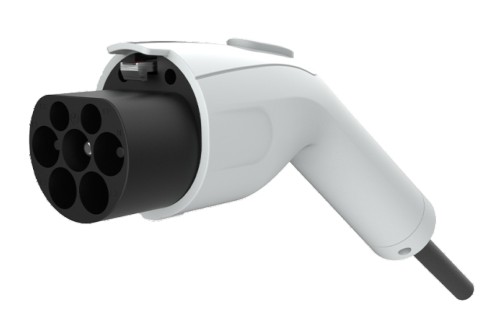
An EV charging cable connects your vehicle to a power source. Getting the specifications right matters for safety, charging speed and durability. A cable that is too long loses voltage, one that is too thin overheats, and one with the wrong connector simply will not fit.

Key Specifications to Consider
Four numbers decide whether a cable is right for your installation: length, amperage, connector type and conductor cross-section. Get these right and the cable will outlast the vehicle.
Length
Standard lengths range from 3 to 10 meters. Measure the distance from your charging point to the car’s port, adding a little slack. A cable that is permanently taut will fail at the strain relief within a couple of years; a cable that is far too long is heavy, awkward and wastes copper.
As a rule of thumb, add 1.5 m to your measured distance. If the run exceeds 10 m, consider a longer cable only after checking voltage drop — on a 16 A single-phase circuit, a poorly specified 15 m cable can lose enough voltage to slow charging noticeably.
Amperage
This determines charging speed. Common ratings are 16 A, 32 A and higher. Ensure your cable rating matches or exceeds your charger output. A 32 A cable on a 16 A charger is fine and gives headroom; a 16 A cable on a 32 A charger is a fire risk and will usually be rejected by the vehicle’s control pilot anyway.
| Rating | Typical power | Use case |
|---|---|---|
| 16 A single-phase | 3.6 kW | Home overnight charging |
| 32 A single-phase | 7.4 kW | Home and workplace wallboxes |
| 16 A three-phase | 11 kW | European workplace charging |
| 32 A three-phase | 22 kW | Destination and fleet charging |
Conductor cross-section
Amperage rating is meaningless without the copper behind it. A 32 A cable needs 6 mm² power conductors; a 16 A cable typically uses 2.5 mm². Undersized copper is the single most common cause of hot connectors and melted plugs, and it is invisible from the outside because the jacket looks identical.
Connector type
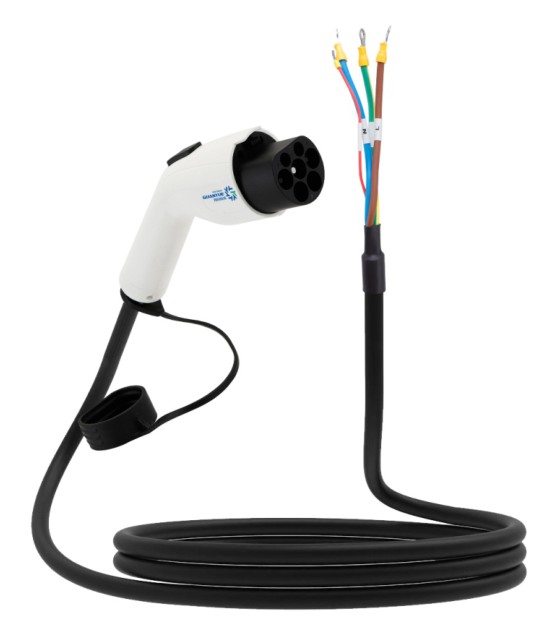
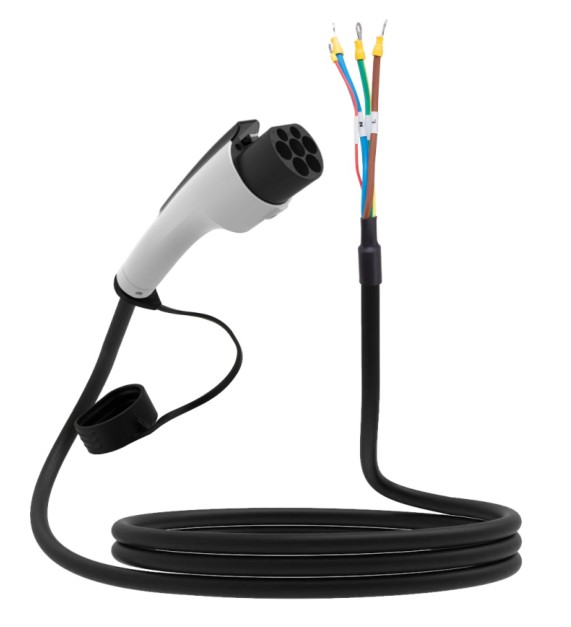
Match the connector to your vehicle and charging standard, such as Type 2, GB/T or CCS. For a like-for-like replacement, see our EU Type 2 AC charging gun cable and GB/T AC charging gun cable (Model A).
Cable construction
Look for certified, high-quality materials that resist heat, wear and weather. The jacket should be halogen-free and flame-retardant, rated for outdoor UV exposure and flexible down to minus 30 °C. Cheap PVC jackets stiffen in cold weather and crack at the strain relief, which is where most cable failures happen.
AC vs DC Cables
AC cables are typically used with portable chargers and wallboxes. DC cables carry high current and are built into DC fast charging guns. Both must meet strict safety standards — see our AC vs DC charging guns breakdown for the engineering detail.
| AC cable | DC cable | |
|---|---|---|
| Core count | 3 or 5 power cores plus pilot | 2 large power cores plus control pins |
| Typical current | 16–32 A | 60–500 A |
| Typical voltage | 250–480 V AC | 200–1000 V DC |
| Weight per metre | 0.3–0.6 kg | 1.5–3 kg |
| Attached to | Wallbox or portable charger | Fixed DC charging station |
| User-replaceable | Usually yes | Rarely — requires a technician |
Signs a Cable Needs Replacing
- Visible cracking or stiffness in the outer jacket, especially near the connectors
- Discoloured or warm-to-the-touch connector pins after a charging session
- Intermittent charging that stops on its own, often logged as a control pilot fault
- Bent or corroded pins, or a latch that no longer clicks firmly
Cable Standards and Certification
A charging cable is a safety-critical component, not an accessory. In most markets it must carry a test report against the relevant standard before it can legally be sold or installed. Connector and cable requirements are published in IEC 62196 for Type 2 and in SAE J1772 for North American AC. In China the equivalent scheme is certified through CQC.
When you buy, ask for documents rather than a logo: the test report for the specific cable family, the temperature and voltage rating printed on the jacket, and the conductor cross-section in mm². A printed CE or UL mark with no supporting paperwork is the most common red flag in this category.
Buying Checklist
Before placing an order, confirm all six points:
- Length: measured distance plus 1.5 m of slack, and no more than 10 m on a single-phase 16 A circuit.
- Amperage: equal to or above your charger output — 16 A, 32 A, or the three-phase equivalents.
- Conductor cross-section: 2.5 mm² for 16 A, 6 mm² for 32 A.
- Connector: matched to the vehicle inlet and to the destination market standard.
- Jacket: halogen-free, flame-retardant, UV-stable and flexible down to minus 30 °C.
- Documentation: test report, rating label and declared conductor size.
Browse our range of AC charging cables and portable EV chargers, or talk to us about custom cable specifications for your project.
Frequently Asked Questions
5 meters suits most home setups, while 7.5m or longer gives flexibility for garages, car parks and commercial installations. Balance reach against voltage drop.
Match the cable to your chargers output. 16A is common for home, 32A for faster single-phase, and higher for three-phase commercial installations.
AC cables carry alternating current between the wallbox and the vehicle. DC cables carry direct current and are thicker, typically attached to DC fast chargers.
Yes. We offer OEM EV charging cables in custom lengths, amperage ratings and connector standards.
No. Domestic extension leads are not rated for continuous high-current loads and are a common cause of fires. If the cable is too short, buy the correct length instead.
Check the printed rating on the jacket against your charger output, and confirm the conductor cross-section. A genuine 32 A cable uses 6 mm power conductors.